

BarnBridge was once considered a rising star in DeFi. It attracted attention by offering structured financial products on the blockchain – primarily yielding assets in risk-tiered tranches – a concept that promised to merge traditional investment mechanics with decentralised systems. The project launched with technical ambition, community governance, and a vision of making complex financial instruments accessible to retail crypto investors.
However, the trajectory of BarnBridge took a sharp turn following a regulatory investigation by the SEC. What began as a bold DeFi experiment eventually became a cautionary tale of centralised control, compliance challenges, and legal accountability.
The Promise of BarnBridge
Launched in 2020, BarnBridge introduced itself as a DeFi protocol offering products that allowed users to manage volatility and risk. The cornerstone of its platform was SMART Yield, a product designed to offer users a choice between fixed and variable returns. Participants could select either a “Senior” tranche, which offered more predictable income, or a “Junior” tranche, which absorbed the volatility of returns in exchange for the possibility of higher yields.
This structure was inspired by traditional finance models, particularly those seen in collateralised debt obligations (CDOs) and mortgage-backed securities. By applying these mechanisms in a blockchain context, BarnBridge hoped to create a more nuanced risk-reward landscape for crypto investors.
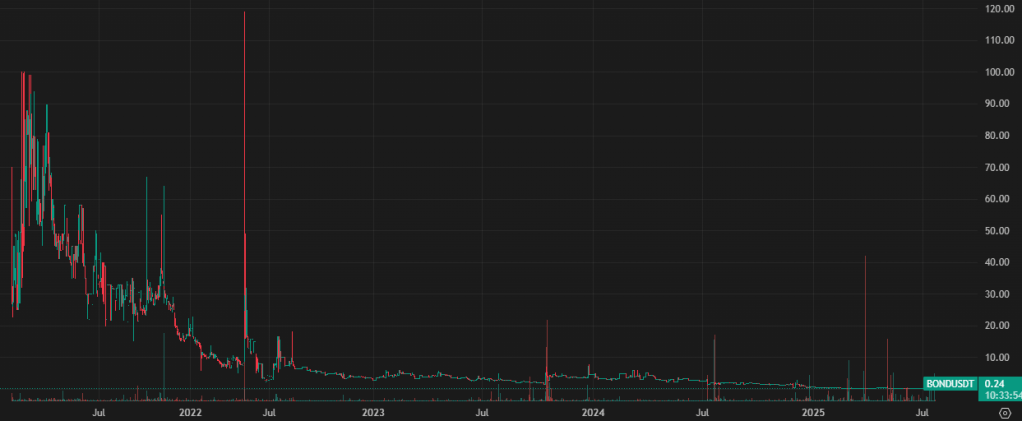
SMART Yield aggregated returns from platforms such as Aave and Compound, distributing them according to each tranche’s role in the risk hierarchy. The approach gained early traction. At its peak, BarnBridge recorded over $300 million in total value locked, and its native governance token, BOND, soared to an all-time high of approximately $185.
The project was seen as innovative and forward-looking. It attracted notable early backers and was regularly cited as an example of how DeFi could offer more than just high-risk yield farming.
Governance and the DAO Illusion
Like many other DeFi protocols, BarnBridge marketed itself as a decentralised autonomous organisation (DAO). In theory, this meant the community of token holders could vote on proposals, manage the treasury, and guide the project’s evolution.
In practice, however, the protocol’s control remained highly centralised. A small group of insiders, particularly its founders Tyler Ward and Troy Murray, maintained de facto authority over development decisions and access to the treasury. Governance votes were often passed with the weight of a few wallets, undermining the principle of broad-based decentralisation.
This dynamic was not uncommon in the DeFi space, but it would later prove to be a critical point when regulators became involved.
The SEC Investigation
In July 2023, the BarnBridge team issued a brief and unexpected announcement: the project was under investigation by the SEC. The founders claimed they had been advised to cease launching new pools, discontinue development activities, and refrain from engaging the community further.
The team then restricted access to its Discord channel and halted nearly all project operations. This announcement sent shockwaves through the community, prompting concerns over capital flight, governance paralysis, and legal exposure.
Observers noted a significant outflow of funds from BarnBridge pools shortly after the news broke. The protocol’s once-thriving product suite was effectively frozen. The DAO, while still technically functional, became inactive.
The Legal Outcome
In December 2023, the SEC formally concluded its investigation and announced a settlement with BarnBridge. The Commission alleged that the SMART Yield product constituted an unregistered security. More strikingly, it argued that BarnBridge functioned as an unregistered investment company.
Under the terms of the settlement, BarnBridge agreed to the following:
- Terminate its SMART Yield product and related services
- Pay over $1.5 million in disgorgement
- Disable its active smart contracts
- Accept that its founders, Tyler Ward and Troy Murray, would pay individual fines and step away from any further involvement in these activities
This marked one of the first times the SEC had successfully taken enforcement action against a DeFi protocol by classifying its operations under the Investment Company Act of 1940. In effect, the agency applied the same rules to BarnBridge as it would to a mutual fund or investment trust operating without registration.
The outcome was seen as a watershed moment. For DeFi founders and participants, it reinforced the reality that regulatory scrutiny was intensifying and that decentralisation in name alone would not suffice as a legal shield.
The Collapse of the Token
In the aftermath of the SEC settlement, BarnBridge’s governance token, BOND, experienced a brief speculative surge. Traders speculated on the token’s relevance or potential for resurrection, causing the price to double over a few days.
This rally, however, proved fleeting. Major exchanges including Binance US announced plans to delist BOND by early 2024. With no product, no roadmap, and no leadership, the token’s value began to erode rapidly.
As of mid-2025, BOND trades at less than one percent of its former peak, hovering around $0.30. It remains listed on some decentralised exchanges, but daily volumes are negligible. Most former supporters have written off the token entirely.
Decentralisation Under the Microscope
One of the most significant lessons from the BarnBridge case relates to the nature of decentralisation. While many DeFi projects label themselves as DAOs, in truth, many are governed by a few individuals with key access rights and control over protocol direction.
BarnBridge’s apparent decentralisation did not protect it from regulatory action. On the contrary, the centralised governance structure allowed the SEC to hold specific individuals accountable and made enforcement more straightforward.
The case has prompted other DeFi protocols to reconsider how they structure their governance models. Some have begun to migrate to more transparent systems with clearer separation between development teams and treasury control. Others are exploring offshore entities or working directly with regulators to create compliant frameworks.
Broader Implications for the DeFi Sector
BarnBridge’s regulatory demise represents more than the downfall of a single project. It reflects a shift in the way authorities approach decentralised platforms. The case has established new legal precedents and increased the urgency for compliance within the sector.
There is now a growing consensus that DeFi is entering a new phase. The experimental era of anonymous development, unchecked innovation, and regulatory grey areas is giving way to a more mature model. This model will likely involve closer coordination with legal advisors, jurisdictional clarity, and a move toward product offerings that are structured to withstand regulatory scrutiny.
Some DeFi projects are now seeking formal registration as financial entities. Others are adapting their governance structures to decentralise power genuinely and eliminate concentrated control. While these steps may add complexity, they are seen as necessary to secure the future of the industry.
Can BarnBridge Be Revived?
Despite the closure of its core operations, the BarnBridge name still carries a degree of brand recognition. Its code remains open source, and its concept continues to hold appeal for those interested in structured DeFi products.
Technically, a revival is possible. A new team could fork the codebase, create a compliant entity, and develop a similar product under a different name or jurisdiction. However, doing so would require significant resources, legal clarity, and a willingness to re-enter a space now fraught with regulatory oversight.
To date, no serious effort has emerged to restart the project. The community is largely dormant, and most of the former leadership has moved on.
A Turning Point for DeFi
BarnBridge began as an ambitious protocol that attempted to bring financial sophistication to the blockchain. Its structured yield products were innovative, its early traction was impressive, and its technical vision was compelling.
Yet its story serves as a powerful reminder that even in decentralised ecosystems, regulatory boundaries remain. The failure of BarnBridge was not due to flawed code or mismanaged funds, but rather a failure to navigate the evolving landscape of financial regulation.
As DeFi continues to mature, the BarnBridge case will be studied closely by founders, investors, and regulators alike. It is a stark example of what happens when ambition meets legal reality, and it signals that the era of regulatory engagement in decentralised finance is well and truly underway.
 Speculatour