
Dr. Copper is looking interesting. Typically seen as a bellwether on a mix of the strength of the economy and inflation, macroeconomics is pulling the market seemingly in two directions. In other words: either to right and up or to the right and down.
Copper Positioning in the Commodity Super-cycle
A lot of precious metals have recently picked up in the tailwinds of gold. Silver is close to its highs and Platinum broke out not many months ago to make an impressive return in the space of a week or so.
Copper, meanwhile, has had mixed returns.
This is despite the fact that the extreme investment into AI data centres is set to worsen a not-insignificant shortage in copper. According to mining.com, the metal “can account for nearly 6% of the capital expenditure of a data center project.” According to analysis from the International Energy Agency, global supplies are projected to fall 30% below required levels by 2035, without intervention.
Such is the ‘threat’ of a copper supply shortage that even the UN announced in March that the “copper shortage risks slowing global energy and technology shift”.
Major speculators have been drawn to this simple demand/supply imbalance. Gold-trading magnate Bian Ximing has shifted his focus to copper, establishing himself as China’s most aggressive copper bull through investments totalling nearly $1 billion.
30th July: Copper Cracks
From August 1st, a hefty 50% import tax slammed processed copper goods including pipes, cables, rods, and sheets, alongside copper-containing manufactured items like connectors, fittings, and electrical hardware. But the levy sidesteps fundamental copper inputs – concentrates, cathodes, anodes, mattes, and ore remain duty-free according to the White House statement.
Following this announcement, the spot copper market declined 19% in a few minutes, its largest single-day drawdown in history.
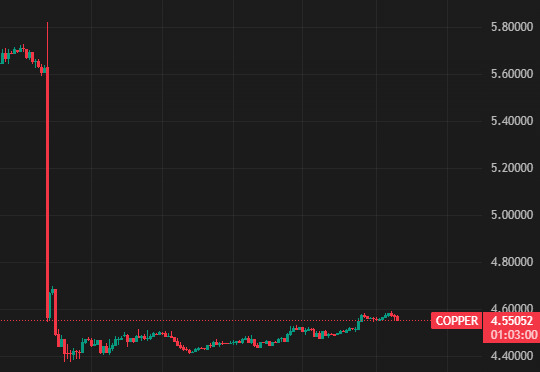
The policy creates a two-tier system: downstream manufactured copper products face steep tariffs while upstream raw materials and refined copper feedstock remain untaxed. This distinction preserves access to basic copper inputs for domestic manufacturers while penalizing finished imports – explaining the market’s violent reaction when traders realized their expectations of blanket copper tariffs were wrong.
The Dr. Copper Thesis
Dr Copper is a nickname given because it is widely regarded as a reliable economic indicator, as the metal is used across an extensive range of industries. For this reason, movements in copper prices are often seen as a reflection of overall economic health.
When demand for copper increases, it usually signals that industrial activity and investment are on the rise, pointing to a strengthening economy. Conversely, when demand declines, it can indicate that manufacturing output is slowing and that economic growth may be under pressure.
Copper is also, however, used by investors as an inflation hedge. And with the U.S. president looking to replace the Fed Chair with a sacrificial dove, we might see aggravating inflation in H1 2026.
WisdomTree’s 3HCL
With the market fundamentals pushing, it is difficult to overlook it as a precious metals play. Spot prices have formed a 15-year cup-and-handle formation, with a breakout signalling a potential 60%+ upside to $7.3 per pound.
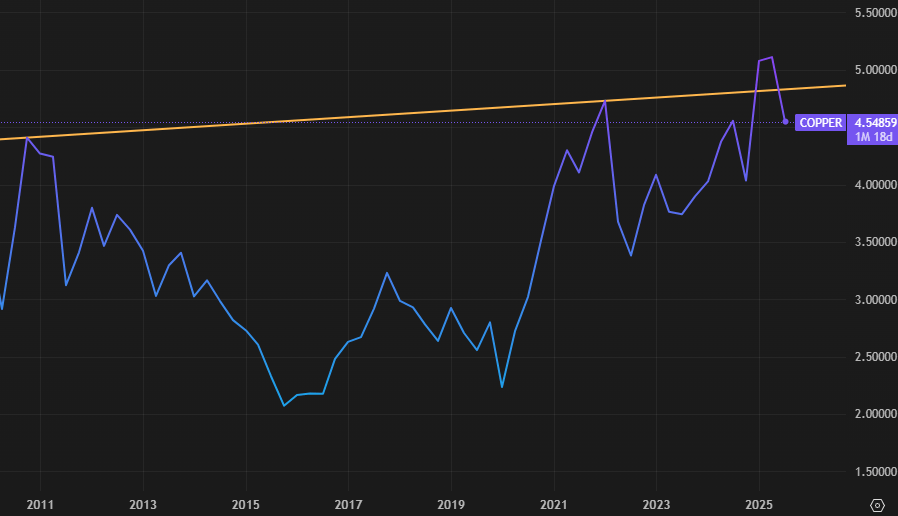
Now, a ~60% return within the decade might not be quite worth it. But a leveraged ETF such as WisdomTree’s 3HCL (Copper 3X Daily Leveraged) might be a winning ticket.
Normally, a 3.28% Total Expense Ratio would certainly be something to balk at. But in a commodity market of sky-high gold, coffee and cocoa prices, a copper bet might be a tidy hedge, turbocharged with a leveraged ETF.
The Speculatour’s Disclosure: Not financial advice. No guidance is provided for any particular investor, asset prices can fall as well as rise. The Speculatour is not a licensed securities dealer, broker, investment bank or advisor.
 Speculatour